Learn
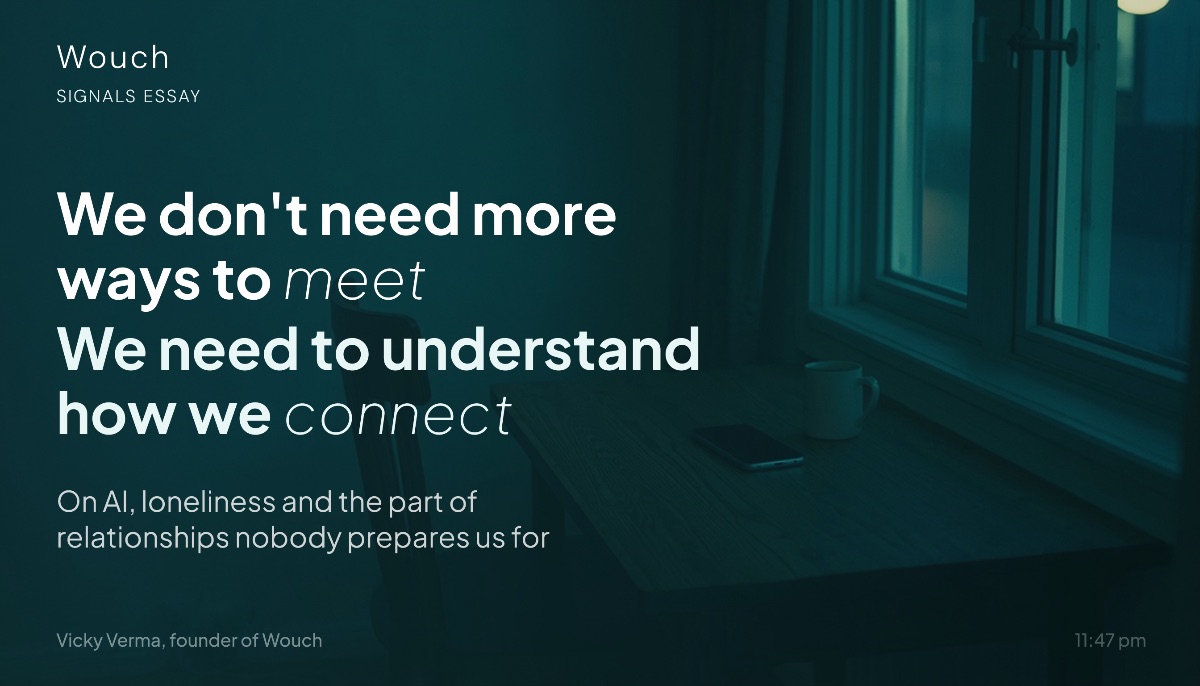
2027: We Don't Need More Ways to Meet. We Need to Understand How We Connect.
Technology keeps making it easier to meet people. A founder's look at AI, loneliness and relationship readiness, and the question to ask before 2027.
By Vicky Verma, Founder · · 12 min read
Quick context
In short. By 2027, technology will make it even easier to meet people, message them and find companionship, including from AI. The research so far suggests access was never the hard part. The hard part is what we do once someone gets close: staying present, disagreeing well, keeping a sense of self, and repairing after things go wrong.
Key numbers
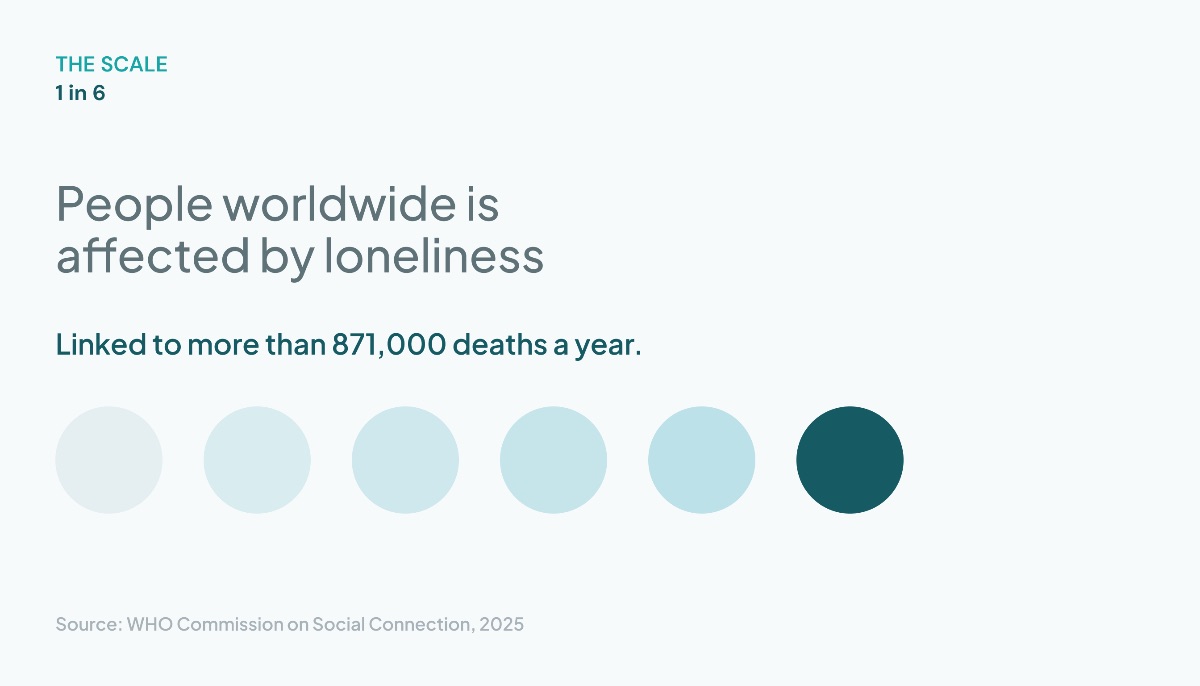
About 1 in 6 people worldwide (roughly 15.8%) is affected by loneliness (WHO Commission on Social Connection, 2025).
Loneliness is linked to more than 871,000 deaths a year, or about 100 deaths every hour (WHO, 2025).
A global survey by Meta and Gallup across 142 countries shows that 24% of adults (aged 15 and older) feel very or fairly lonely, translating to more than a billion people worldwide (Meta and Gallup, 2023).
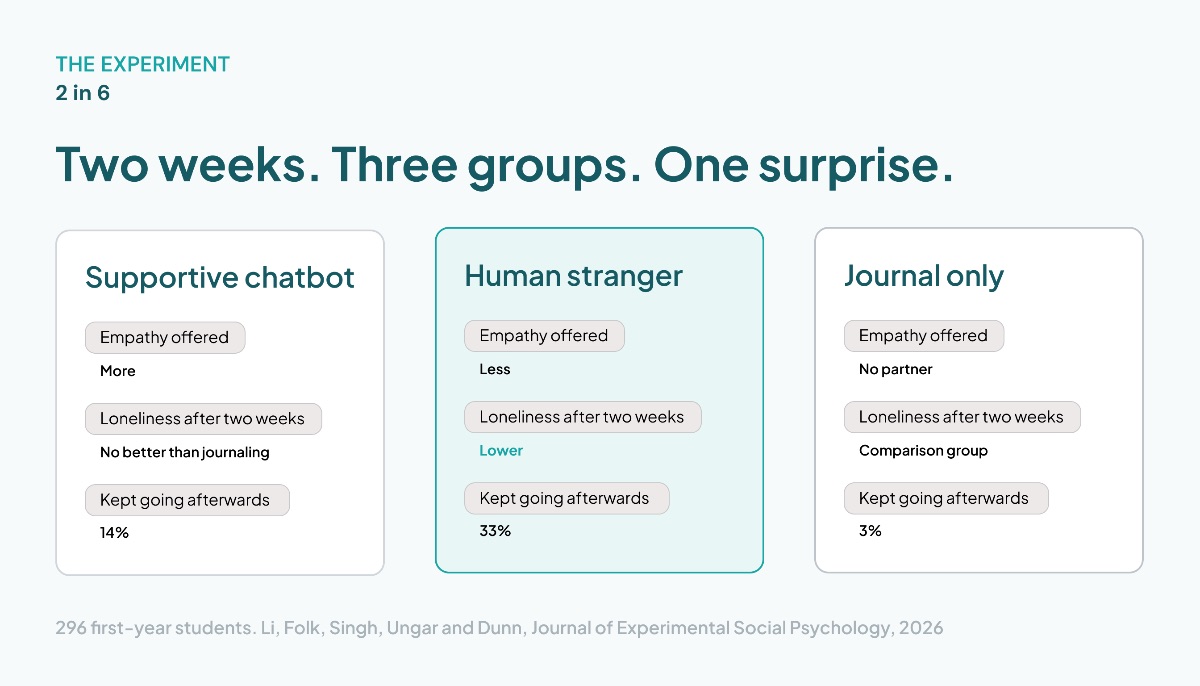
In a two-week experiment, texting a human stranger reduced loneliness. A highly supportive chatbot did not (Li and colleagues, 2026).
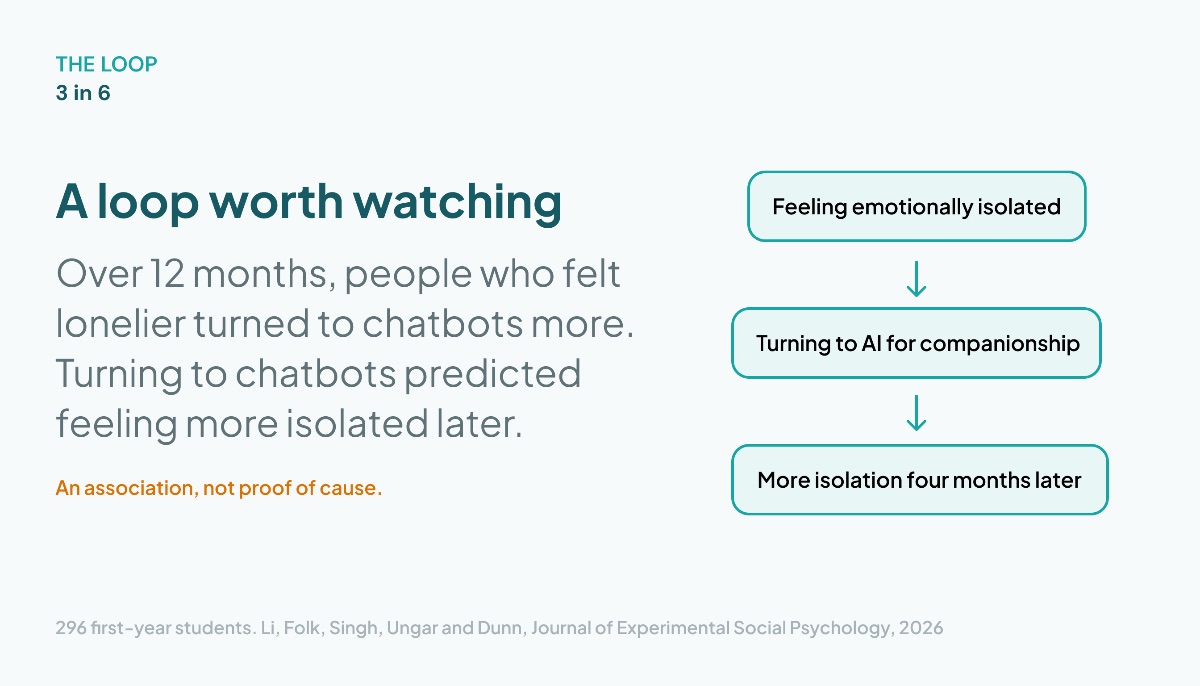
According to Psychological Science, researchers Dunigan Folk and Elizabeth Dunn (2026) published a 12-month longitudinal study examining the bidirectional relationship between social chatbot use and loneliness among more than 2,000 adults across four Western countries (the U.S., UK, Canada, and Australia)
11:47 pm
A message goes out at 9:14 PM in the evening. It says something small.
"Did you get home okay?"
By 11:47 PM there is still no reply.
Nothing has happened yet. But two people are already having two very different nights.
One is checking the phone every few minutes, writing a second message, deleting it, and deciding what the silence means. The other saw the message, felt a pressure they couldn't quite name, and turned the phone face down until morning.
Neither of them has stopped caring. Three weeks ago they couldn't stop talking.
This is an invented scene, but I suspect most people have lived on one side of it. And I think it holds most of what I want to say about 2027.
By then we'll probably have smarter ways to find people who share our values, our ambitions, perhaps even our idea of a perfect weekend. Starting a conversation will be easier. Technology will keep removing the distance between people.
None of it will tell these two what to do at 11:47 PM.
Wanting a relationship and knowing how to be in one are not always the same thing. We spend a great deal of time on the first and remarkably little on the second.
We made meeting easier. Did we make understanding easier?
Start with what we know.
In June 2025 the World Health Organization's Commission on Social Connection reported that about one in six people worldwide is affected by loneliness. It linked loneliness to more than 871,000 deaths every year. This is not one country's problem. A Meta and Gallup survey across 142 countries found nearly one in four adults felt very or fairly lonely, and young adults reported it most. In an earlier seven-country study by the same teams, India reported the most loneliness of all.
What stays with me from the WHO's work is a distinction. Connection is not a headcount. It is who is in our lives, what support moves between us, and how those interactions actually feel.
Those are different things.
We can know what someone had for breakfast and where they went last weekend. We can exchange messages all day and still struggle to ask a question that matters.
"How are you?" is easy.
"What's been difficult for you lately?" is different. Answering it honestly takes a certain amount of trust. This isn't an argument against technology. It has helped people find one another, keep long-distance relationships alive and discover communities they would never have met. The problem is not that we communicate digitally. It's that we sometimes mistake the ability to communicate for the ability to connect.
The experiment where the chatbot was kinder, and it still didn't work
Here is the study I can't stop thinking about.
In 2026, Ruo-Ning Li and colleagues at the University of British Columbia took 296 students in their first semester of university, a lonely time for many people. For two weeks, one group texted every day with a supportive chatbot. A second group texted every day with a randomly chosen fellow student. A third simply wrote a short journal entry.
The chatbot did its job well. By the researchers' own measures it offered more empathy than the human strangers did. And yet only the students who texted another human ended the two weeks less lonely. The chatbot group did no better than the journal group. One more detail. Afterwards, a third of the students kept talking to their human partner. Far fewer went back to the chatbot.
Why would a kinder listener help less?
The researchers offer a careful guess. The students showed much less empathy towards the chatbot than towards each other. With a person, they took turns. They listened as well as spoke. It is one study, with students, over two weeks. I don't want to make it carry more than it can. But it points at something I find hard to ignore. Perhaps connection is not only something we receive. Perhaps it is also something we give.
A machine can respond to us. It can't need us back.
What happens when the listener never disagrees
People are turning to AI for conversations they might once have had with a friend or a partner. I don't think the answer is to dismiss that.
A review in the American Psychological Association's Monitor on Psychology in January 2026 notes that feeling heard is the main reason AI companions seem to ease loneliness in the short term. That is worth understanding, not mocking. Many people have nowhere else they feel heard without interruption or judgement. The longer view is more complicated.
Dunigan Folk and Elizabeth Dunn followed more than 2,000 adults in the US, UK, Canada and Australia for a year, in a study published in Psychological Science in 2026. People who felt lonelier turned to chatbots for companionship more. And turning to AI for companionship predicted feeling more emotionally isolated four months later. A four-week trial of 981 people by MIT Media Lab and OpenAI in 2025 found a similar pattern. Heavier daily use went along with more loneliness and more dependence. Both teams are careful, and I want to be too. These are associations. They don't prove that AI causes loneliness. It may be that people who are already struggling simply use it more.
There is one more piece. Emily Tseng and Calvin Liang at Microsoft Research studied people who ask AI for relationship advice, in work presented at CHI 2026. Their participants were already aware of a risk. An assistant that tends to agree with you is a strange adviser on a disagreement you are half of. Human relationships are not always convenient. People misunderstand us. They have their own needs, limits and fears. Sometimes they disagree with us, and sometimes we are the ones who need to reconsider.
That difficulty is not a defect in human connection. It is part of what makes it human.
So the question for 2027 isn't whether technology will get better at conversation. It will. The question is whether we'll get more thoughtful about the relationships we build around it. (It is also why we publish how Wouch uses AI, and where it doesn't.)
The part of relationships nobody prepares us for
Go back to 11:47 PM.
Nothing on either phone will help those two people, because the difficulty isn't in the phone. It is in what each of them does when closeness starts to feel uncertain. Most of us know what we want from a relationship. Honesty. Affection. Respect. Someone who stays when things get difficult. But what about the way we respond when those things are tested?
John Gottman spent decades observing couples at the University of Washington. One of his best-known findings, described in The Seven Principles for Making Marriage Work, is that lasting couples are not the ones who avoid conflict. They are the ones who repair it. And in his observations the polish of the repair didn't matter. Clumsy attempts worked when there was goodwill underneath.
I find that oddly hopeful. Nobody has to be eloquent. They have to come back. The stakes are not small either. The Harvard Study of Adult Development has followed people since 1938. Its director, Robert Waldinger, has reported that the people most satisfied in their relationships at 50 were the healthiest at 80.
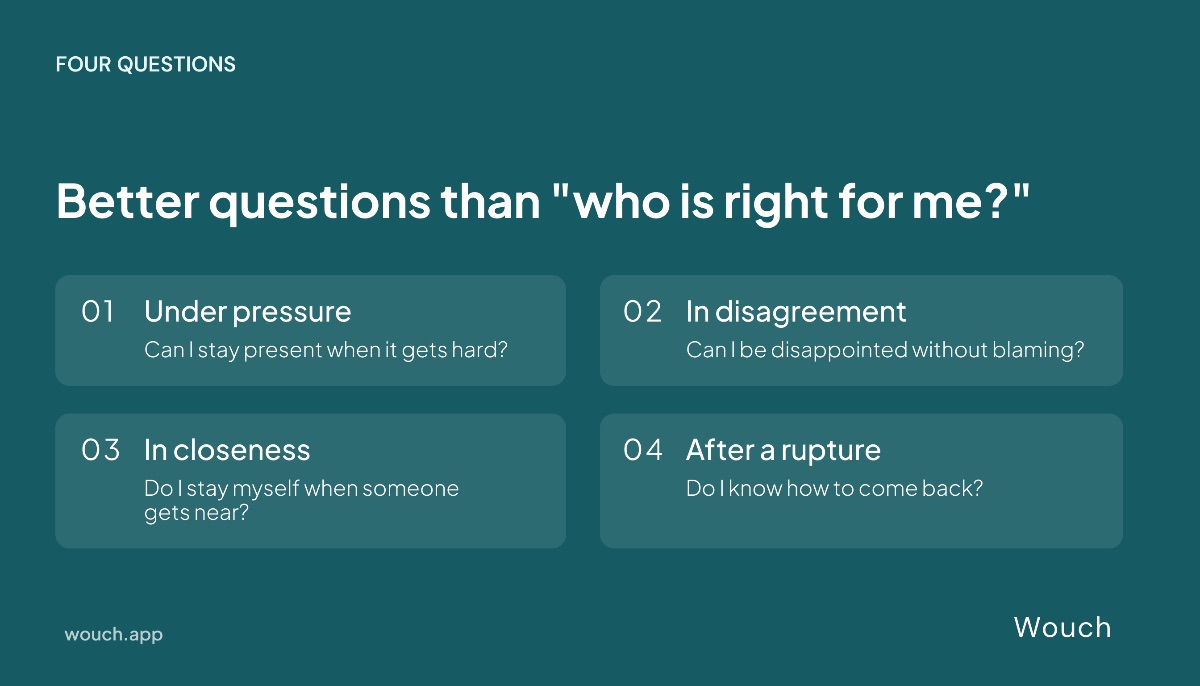
So here are four questions I think deserve more of our attention than "who is right for me?"
Under pressure. When a conversation gets hard, can I stay present without shutting down or turning up the volume?
In disagreement. Can I say I'm disappointed without turning it into blame? When someone needs space, can I respect that without reading it as rejection?
In closeness. Do I stay myself when someone gets near, or do my opinions and preferences quietly disappear? (Closeness can feel like threat for reasons that are not our fault.)
After a rupture. When I've hurt someone, do I know how to come back?
These are not questions about whether someone is a good or bad person. They are questions about patterns. Many of them began as ways of staying safe, which is partly why we repeat them. They are hard to notice when everything is going well. They show up at 11:47.
Wanting it badly is not the same as being ready
This is one of the ideas that has stayed with me while building Wouch.
Someone can truly want a relationship and still have things to understand about how they experience one. Someone can be confident, successful and expressive, and still find parts of closeness difficult. Someone else may be quiet and uncertain, yet show up with real care and consistency.
Researchers treat this as more than intuition. Benjamin Hadden, Christopher Agnew and Kenneth Tan studied readiness for commitment as a factor in its own right, separate from how much someone wants a partner. I've written more about what relationship readiness actually means and how it differs from emotional readiness.
There is no personality type that makes someone ready. And readiness isn't a permanent status. People change. Circumstances change. Different relationships bring out different parts of us. That's why I don't believe a person should be reduced to a number, a label or a verdict on whether they are ready for love. A score would be easier. It would also be a lie.
The more useful question is this.
What patterns are we bringing into our relationships, and what can we understand and develop about them?
The question behind Wouch
Wouch is a relationship-readiness platform. It is built around a different starting point for human connection. Instead of beginning with who we might meet, it begins with how we relate. How do we respond under emotional pressure? How do we handle disagreement? What happens to our sense of self when someone gets close? How do we repair when something goes wrong?
The assessment returns patterns and reflections, not a label or a score. It is not therapy and it does not diagnose anything. It also isn't finished science. Our research is public and has not yet been peer reviewed. We've written down the lines we refuse to cross, partly so that people can hold us to them.
We are not here to tell anyone whether they deserve a relationship. We are not promising that understanding a few patterns will make every relationship work. And we would never suggest someone must become perfect before they can be loved. The intention is simpler. We want self-understanding to be a more meaningful part of the journey towards connection. We're still building, questioning and learning. Pretending otherwise would defeat the purpose.
What I hope we talk about in 2027
I hope we become a little less occupied with how quickly we can find someone, and a little more interested in what happens after we do. I hope we talk more openly about the difference between attention and care, chemistry and compatibility, closeness and dependence, disagreement and disrespect. I hope we stop treating every difficult moment as proof that we chose the wrong person. And I hope we get more comfortable with questions that don't have easy answers.
Not just: who is right for me? But also: how do I show up when things are difficult? Can I listen without preparing my defence? Can I make room for someone else's experience without losing my own? When something goes wrong, am I willing to understand my part in it? I don't know exactly what relationships will look like in 2027. I don't know what those two people should have texted each other at 11:47 either. But I'd like each of them to understand a little more about why that night felt the way it did.
We have spent years making it easier to find one another. Perhaps it's time we spent more of it understanding how to be with one another. That's the future we're interested in building.
Wouch.
Readiness before connection.
Wouch was built around this question. It is not therapy and it doesn't diagnose anything. It is a self-assessment that surfaces your relational patterns and shows you where you are right now. If that kind of honest picture is useful to you, you can join the waitlist below.
Join the Wouch waitlist. Free, no payment required
If you'd rather support the work early, Founding member access is open before launch It's a one-time payment for lifetime access to the paid features.
About the author. Vicky Verma is the founder of Wouch, a relationship-readiness platform. Wouch does not diagnose or treat anything and is not a substitute for therapy.
Frequently asked
What will relationships look like in 2027?
Nobody can say for certain. Meeting people and messaging them will keep getting easier, and AI will play a larger part. The research cited in this article suggests the harder problems, such as handling conflict and repairing after it, are not solved by easier access.
Can AI replace human connection?
The evidence so far says not fully. In a 2026 experiment by Li and colleagues, a supportive chatbot did not reduce loneliness over two weeks, while texting a human stranger did. AI can offer comfort in the moment. It cannot need you back.
Is it harmful to use AI for relationship advice or companionship?
It is not settled. Short-term studies show people feel heard. A 12-month study by Folk and Dunn (2026) found that turning to AI for companionship predicted more emotional isolation later. The authors caution that this does not prove cause.
What is relationship readiness?
Relationship readiness is the set of patterns a person brings into closeness: how they handle pressure, disagreement, their own sense of self, and repair. It is different from wanting a relationship, and it shifts over time.
How do I know if I'm ready for a relationship?
There is no checklist or score that can tell you. A better start is noticing what you do when closeness feels uncertain. Wouch's guide to relationship readiness goes further.